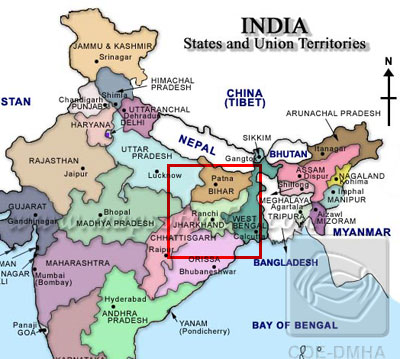
India's bloodiest war zone
A vast thickly forested area in the heart of India has become the
country's bloodiest war zone, with hundreds of security personnel pitted against
Maoist guerrillas and impoverished tribespersons caught in between.
Chhattisgarh politicians and officials say that some 45,000
tribal people, assisted by paramilitary troops and police, have taken on the
Maoists in the 10,238 sq km territory in Dantewada district in this central
Indian state.
Shedding all inhibitions, the Bharatiya Janata Party (BJP)
government is arming and financing men and women who have thrown their lot with
the state in the campaign against the outlawed Communist Party of India-Maoist.
The militias are putting up a tough fight against the more
motivated guerrillas - but taking heavy casualties too.
The 86 deaths in Dantewada this year, including that of 20
policemen, is much higher than the fatalities reported in violence-hit Jammu and
Kashmir and the northeast region put together, officials say.
In the process, Dantewada, which borders Maharashtra, Orissa and
Andhra Pradesh, is witnessing an armed campaign not seen in the history of the
country's four decades old Maoist movement.
The state government, which enjoys the backing of the main
opposition Congress party as well as New Delhi in its fight against the Maoists,
says it is determined to crush the guerrillas who have set up a parallel
administration in much of the sprawling district.
Officials admit that the Maoists enjoy sway over 12,000 sq km in
the Bastar region's Abujhmarh forest. The rebels have planted landmines all
around, and not a single policeman dares to enter the zone.
The government-sponsored militias seek to woo local tribes in the
name of "Salwa Judum" (Peace Mission) that was launched in June last
year by opposition leader Mahendra Karma of the Congress who now tops the
guerrillas' hit list of "class enemies".
"We have no option. The Salwa Judum movement has begun. The
tribal people have to come to us or stay with the Maoists. There is no middle
path," Karma told IANS.
Dantewada's 1.1 million people are mostly tribal. The area has
one of the world's largest iron ore reserves with stocks that can feed India's
fast growing steel industry for the next few centuries.
Dotted with hills and covered by forests, it is also one of
India's most impoverished regions. The tribals inhabiting the 1,349 villages
mainly depend on hunting, forest products and agriculture for their humble
living.
"I know the rebels have been butchering tribes who have been
supporting the government in the armed struggle, but democracy will eventually
triumph over the Maoists," Chief Minister Raman Singh declared in Raipur,
the state capital.
He added that nearly 45,000 people had been displaced since June
2005 and were living in government relief camps guarded by the Central Reserve
Police Force (CRPF) and the police.
Amid allegations of human right violations, the government
provides sophisticated weapons such as AK-47 rifles to members of the militia
who until now knew nothing apart from the traditional bow and arrows.
Maoists who surrendered to the authorities are also being helped
to take on their former comrades after being grouped as special police officers
(SPOs).
"The SPOs have a single task: to fan out in the Maoist den
and dismantle their terror network. The government offers Rs 1,500 a month to
the SPOs who have never earned a single rupee in their life," Home Minister
Ramvichar Netam said.
A desperate government set up a Counter Terrorism and Jungle
Warfare College in August 2005 in the Bastar region to train policemen to fight
"a guerrilla like a guerrilla".
Said former Indian army official BK Ponwar, director of the
college: "Salwa Judum is the best way to flush out Maoists. They will
definitely take revenge by massacring tribals supporting the government. But it
is the only option to prevent them from going over to the Maoists."
(Source : Hindustan Times)